
Organizational Architecture
The work that makes everything else possible.
For businesses that know lasting performance begins with the right foundation.
$20M
Unlocked in Billable Revenue
30%
Reduction in customer escalation risk
40%
Increase in employee satisfaction
The Problem
Every organization is paying for its architecture somewhere.
The burden shifted,
not eliminated.
-
Pipeline was never the main constraint. Growth plans keep assuming an operating model that was never built to hold them.
A ceiling inherited, not intentionally designed.
-
Work that should take one decision takes four approvals. The hours never appear on a budget line, yet quietly sabotage every budget line.
Margin erosion with no clear name.
-
Financial forecasts paint a beautiful picture. Month-end reconciliations demonstrate reality. The variance has its own forecast.
Working capital, trapped in bureaucracy.
-
Decisions live in people’s heads rather than in the structure. When the one person who “just knows how it works” leaves, chaos ensues, fast.
Exposure that never made the register.
-
What held together at last year’s size doesn’t bend at this year’s. Breakdowns multiply at the same unfixed seam. Failures outpaced prevention.
Cracks that scale faster than revenue.
-
Tokens are maxed out, and the licenses renew. The tools digitize the same confusion and workarounds that everyone already had before they appeared.
The tools’ capability outpaces clarity.
-
Exceptional people rarely quit the company. They quit the system that chronically exhausts them. The resignation is just paperwork.
The exit before the resignation.
-
Service depends on who manages the work, not what the organization promised. Customers feel dissatisfaction long before they voice it.
Reliability that shapeshifts.
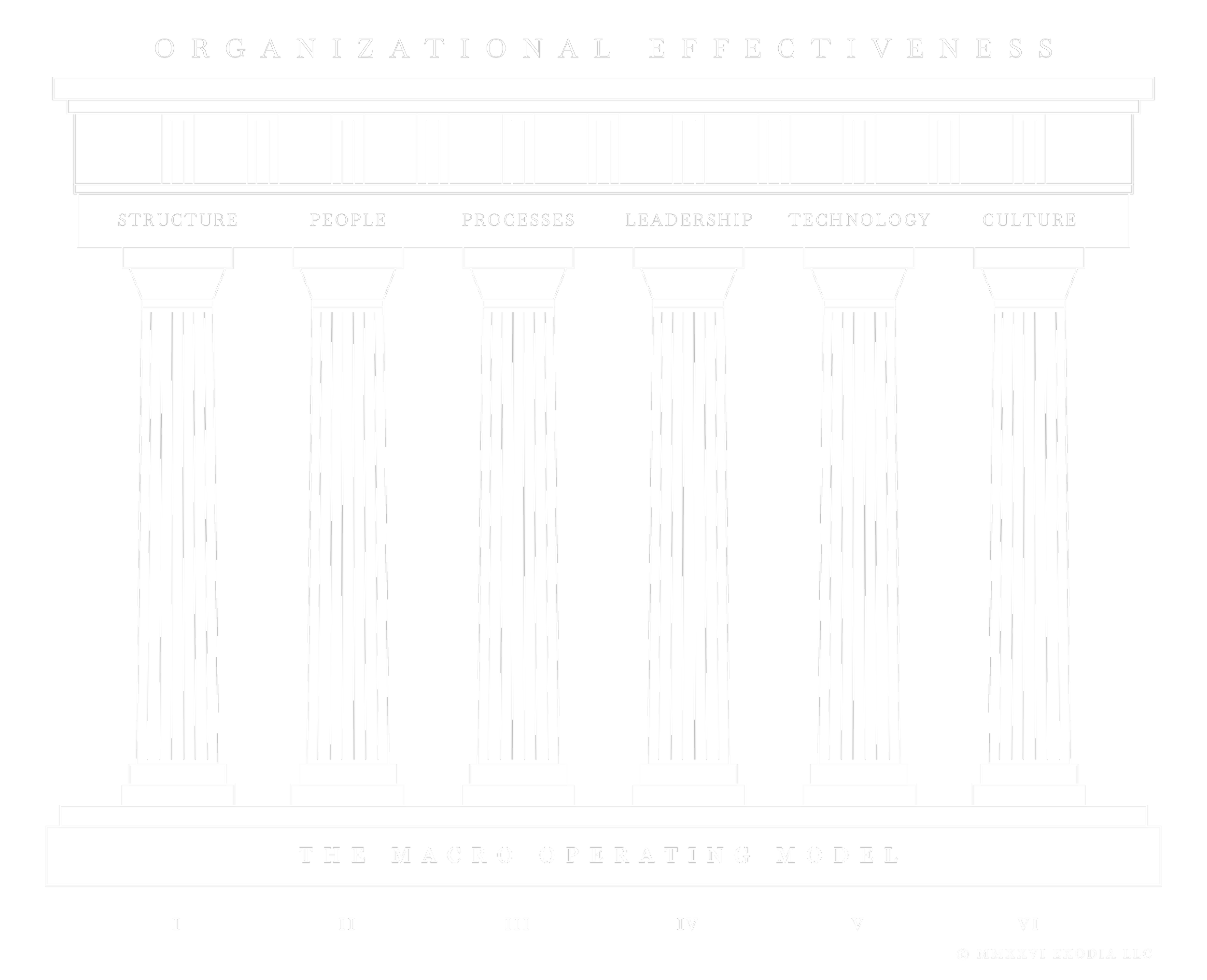
Six disciplines,
one structure.
Every engagement draws on all six.
An organization stands on nothing less.
Phuong Anh Nguyen
Principal
Phương Anh began her career in health care. Not as a clinician, but as someone asking a harder question: what if the real intervention happens before anyone gets sick?
That question never left her. Through clinical operations. Into commercial solar infrastructure, where she delivered 40+ multi-year EPC projects in some of the most complex execution environments in the industry. In every room she worked, the same pattern revealed itself: exceptional people constrained by systems that were never intentionally designed. Just accumulated.
The industries changed. The dysfunction didn’t.
So she stopped working inside broken architecture and started building better ones. Exodia is the result, and it’s where she gets to heal and empower people through systems design. The business world refers to it as operations architecture. Either way, the work is the same: address the structural level before the symptoms become the story.
Her work creates the conditions for organizations to go further than their current infrastructure ever allowed. Not by pushing harder, but by removing what has been quietly holding them back.
For her, it has always been the same work. Just finally upstream where it counts.

The Exodia Philosophy
“You cannot change people.
But you can build the conditions that let them grow into who they’re capable of becoming.”
— Phương Anh, Principal
An Exodia Engagement
For those who understand the foundation is legacy,
not luxury.
A transformation journey designed to meet you where you are.
-
An intensive with the principal and your relevant stakeholders. The current organizational architecture gets mapped, and the structural constraint(s) that generate the symptoms get named. You leave with a diagnostic map and the first domino identified. Clarity you can act on immediately.
Best for leadership teams who feel the friction and bleeding but can't yet name the source.
-
A defined transformation with a measurable beginning, middle, and end. We assess the operational debt, design the fix, and run implementation through full integration: governance, roles, workflows, tools migration, and cross-functional alignment rebuilt to hold weight. You get a functional system, not a deck.
Best for organizations undergoing restructures: mergers and acquisitions, joint-ventures, rapid growth and expansions.
-
Embedded operational leadership, without the full-time commitment. The principal steps into the seat as the integrator, business systems architect, and carries defined workstreams at a fraction of a loaded executive hire. Full capability, flexible term, clean handoff whenever you're ready to hire permanent.
Best for organizations in transition with an open leadership gap and can't wait for the unicorn candidate.
-
Ongoing operational counsel for systems already in motion. A standing monthly partnership: priorities reviewed, friction caught early, decisions pressure-tested before they cost you a quarter. The steady hand that keeps a working machine working and compounding. Systems drift without stewardship.
Best for proactive leadership teams who want a consistent operational thought partner, without adding FT headcount.
Limited engagements p.a. Every organization accepted works directly with the principal.